
This year’s Southeast Asia 500, Fortune’s annual ranking of the region’s largest companies by revenue, captures a corporate landscape pulling in two directions at once.
At the top, the commodity and energy giants that have anchored the list since its 2024 debut are slowing down. Yet sluggishness at the very top is masking dynamism throughout the rest of the list, as a new generation of firms—whether Vietnamese conglomerates, Singaporean banks, or once-loss-making digital platforms—is capturing a greater share of regional revenue and profits.
Companies on this year’s list generated $1.88 trillion in revenue, up 3.4% from the $1.82 trillion reported on the 2025 list. That’s also a faster growth rate than observed last year, despite concerns that U.S. President Donald Trump’s tariffs might disproportionately hurt ASEAN economies. Total profits reached $150 billion, meaning the region enjoyed a 8% net margin, which owes as much to corporate restructuring, like the turnaround at Thai Airways, as it does to economic tailwinds.
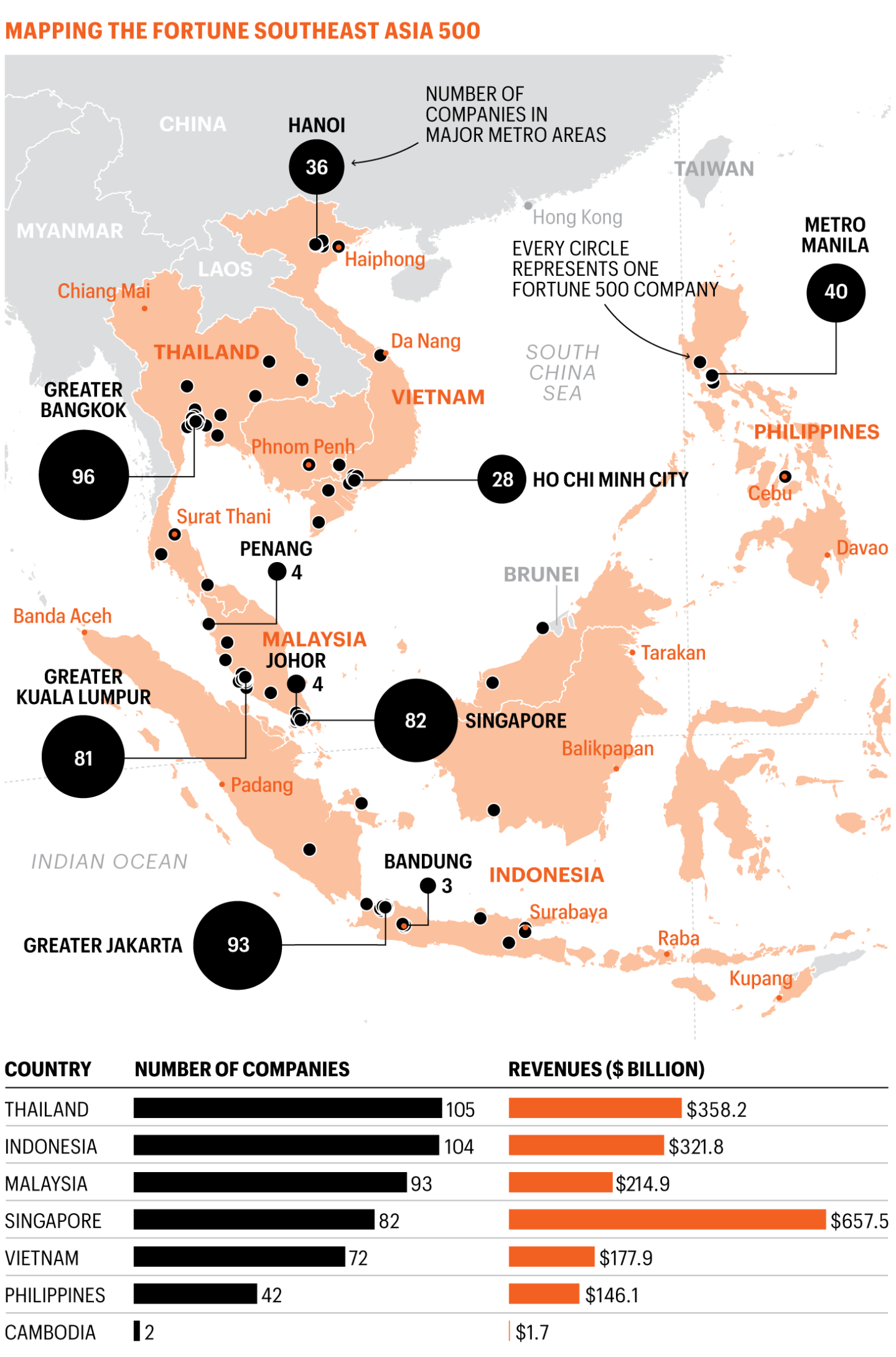
Thailand and Indonesia have the most companies on the list, with 105 and 104, respectively. Singapore leads on revenue, with its SEA 500 companies generating $657.5 billion, just under 35% of the total.
But it’s Vietnam that’s most exciting. Vietnamese firms on the list generated $177.9 billion in revenue, up 10.5%; that’s triple the regional average and the fastest growth of any country on the ranking, save for tiny Cambodia. Overall, Vietnam is responsible for roughly a quarter of this year’s revenue growth on the SEA 500, despite representing less than 10% of its total revenue base.
Revenue at Vingroup, No. 26, jumped 69% to $12.8 billion, making it the only firm in the top 50 to be one of the fastest-growing. Vingroup’s role as national champion was reinforced in 2025 when the Politburo elevated the private sector as the “most important driving force” of Vietnam’s economy.
If Vietnam is a revenue story, then Singapore is all about profits. The city’s “Big Three” banks—DBS Group, OCBC, and UOB—are again among the region’s most profitable companies; DBS, with $8.4 billion in profit, remains No. 1 on the profitability rankings.
Five Singaporean firms are among the companies that showed the greatest jumps in profitability. Sea, No. 12, nearly quadrupled its profit to $1.58 billion as all three of its operating engines—Shopee, Monee, and Garena—delivered record profits.
Thailand gives us two of the year’s most impressive turnaround stories. Thai Airways International, No. 67, which exited bankruptcy protection in 2025 and re-listed on the Stock Exchange of Thailand that same year, swung from a $764 million loss to a $941 million profit. True Corp., No. 62, also returned to profitability after it cleared heavy merger-related write-downs from 2024.
The award for biggest jump on the list goes to an Indonesian company, gold jewelry maker Hartadinata Abadi, which climbed 115 positions to No. 129. Higher gold prices, rather than sales volume, drove the jump.
The Southeast Asia 500, like all of Fortune’s 500 lists, looks backward, ranking companies according to 2025 revenue. Even as Southeast Asia shrugged off Trump’s tariffs, a new threat looms. War in Iran is hiking energy prices across the region. We’ll have to wait for next year’s list to learn whether Southeast Asia can shrug off an energy crisis as well as it did a tariff one.
This article appears in the June/July 2026: Asia issue of Fortune with the headline “A two-speed Southeast Asia 500 takes shape.”