
➡️ Did someone forward you this email? If you would like to receive this information directly, every morning before the markets open in New York, sign up here.
ONE BIG THING
Elon Musk delivers ‘totally nuts’ ‘super sci-fi’ ‘ridiculously profound’ plan for moon robots—and the stock tanks
They bought the rumor and sold the news: SpaceX shares rose 9.43% yesterday before the closing bell and then, overnight, declined 10.8% after Elon Musk delivered the company’s Q2 results in its first-ever post IPO earnings call. Traders were spooked by the company’s $18.4 billion in capex, way more than the $13.2 billion analysts had expected.
Revenue nearly doubled year-over-year to $7.8 billion, above expectations of $6.9 billion. The net loss declined by nearly half to $541 million, Fortune’s Amanda Gerut reports.
As is his custom, Musk offered a rose-colored outlook for the rocket-and-connectivity AI giant, proclaiming that SpaceX’s internal target for hitting $1 trillion in annual revenue had moved forward a full year since the IPO from 2031 to 2030, with a “non-zero chance” it hits the mark in 2029.
In the not-so-distant future, Musk said, his robots will be manufacturing on the moon. From there, moon-based robots will enable SpaceX to build a mass accelerator with solar production. Musk admitted it all sounded “totally nuts” and “it sounds super sci-fi right now, but it’s going to happen.”
“It’s really a ridiculously profound difference,” he said. “But that is our plan, and I think we will achieve that plan.”
MORE FROM FORTUNE
How AI is Learning to Hack Itself – Fortune Daily with Ellie Austin
From Pochettino to MLS, the giants of American finance keep making big promises about the future of U.S. soccer – Catherina Gioino
Europe’s AI sovereignty is under threat. Could Mistral be the answer? – Bea Nolan
Europe’s tech sovereignty is facing its biggest test yet – Sam Forsdick
Billionaires have been flooding the midterms with cash, but one of the GOP’s most reliable megadonors just went silent – Sydney Lake
Trump’s tariffs were supposed to boost American manufacturing, but the new levies are actually pushing some companies back to China – Sasha Rogelberg
Gen Z’s anti-capitalist brand says one thing. Its spending data says something more interesting – Nick Lichtenberg
Sir Martin Sorrell has identified the key AI skill for the future: ‘People who share will be the new kings and queens’ – Kamal Ahmed
THE RESTART OF THE DEAL
Deal with Iran on the Strait of Hormuz could come today
President Trump could announce a deal to reopen the Strait of Hormuz as soon as today, according to Axios. Sources told the site that Iran and Oman have sketched an agreement in which Iran controls the northern route for inbound traffic while Oman controls the southern route for outgoing vessels. The agreement would include a 60-day ceasefire and no tolls on traffic.
The news, while hopeful, comes with a truckload of caveats:
- It does not include any agreement on Iran’s nuclear program, which was Trump’s top priority for the war, according to Secretary of State Marco Rubio as quoted in the WSJ.
- It would give Iran partial control of the Strait, which it did not have before the war.
- Iran denied the Strait would reopen immediately, according to Al Jazeera. “The reopening of the Strait of Hormuz depends on a change in U.S. behaviour and the correction of its violations,” an Iranian source told the channel.
Context: We have been on this carousel before. Both Iran and Trump can scuttle the deal with a single round of bombing. And the Houthis, Iran’s Yemeni proxy terror group, attacked another Saudi ship in the Bab al-Mandeb this morning, their eighth strike on Saudi ships so far. There is no indication yet that any deal will include opening the Red Sea route.
“This would probably mean tolls eventually (probably branded a ‘tariff’ or an ‘environmental charge’ according to political bias). A toll would be economically negligible. Iran cementing control of the Strait has implications for insurance, supply chain security, and Gulf infrastructure investment,” Paul Donovan at UBS commented this morning.
THE MARKETS
Stocks up across the board as oil declines on hopes of Iran ceasefire
- S&P 500 futures were up 0.28% this morning. The index rose 1.79% yesterday to a record high of 7,736.52.
- In Europe, the Stoxx 600 was up 0.06% in early trading and the U.K.’s FTSE 100 was up 0.18% before lunch.
- Asia: South Korea’s KOSPI was up 3.76%. Japan’s Nikkei 225 was up 3.66%. India’s Nifty 50 was down 0.39%. China’s CSI 300 was up 1.24%.
- Brent crude sank as low as $77 per barrel in the last 24 hours before rising to $80 this morning.
- Bitcoin was $64K.
Palantir rose an astonishing 29.45% yesterday after it delivered Q2 earnings that vastly exceeded expectations. The stock gave back 2.85% in overnight trading. This chart, covering the last five days, says it all:
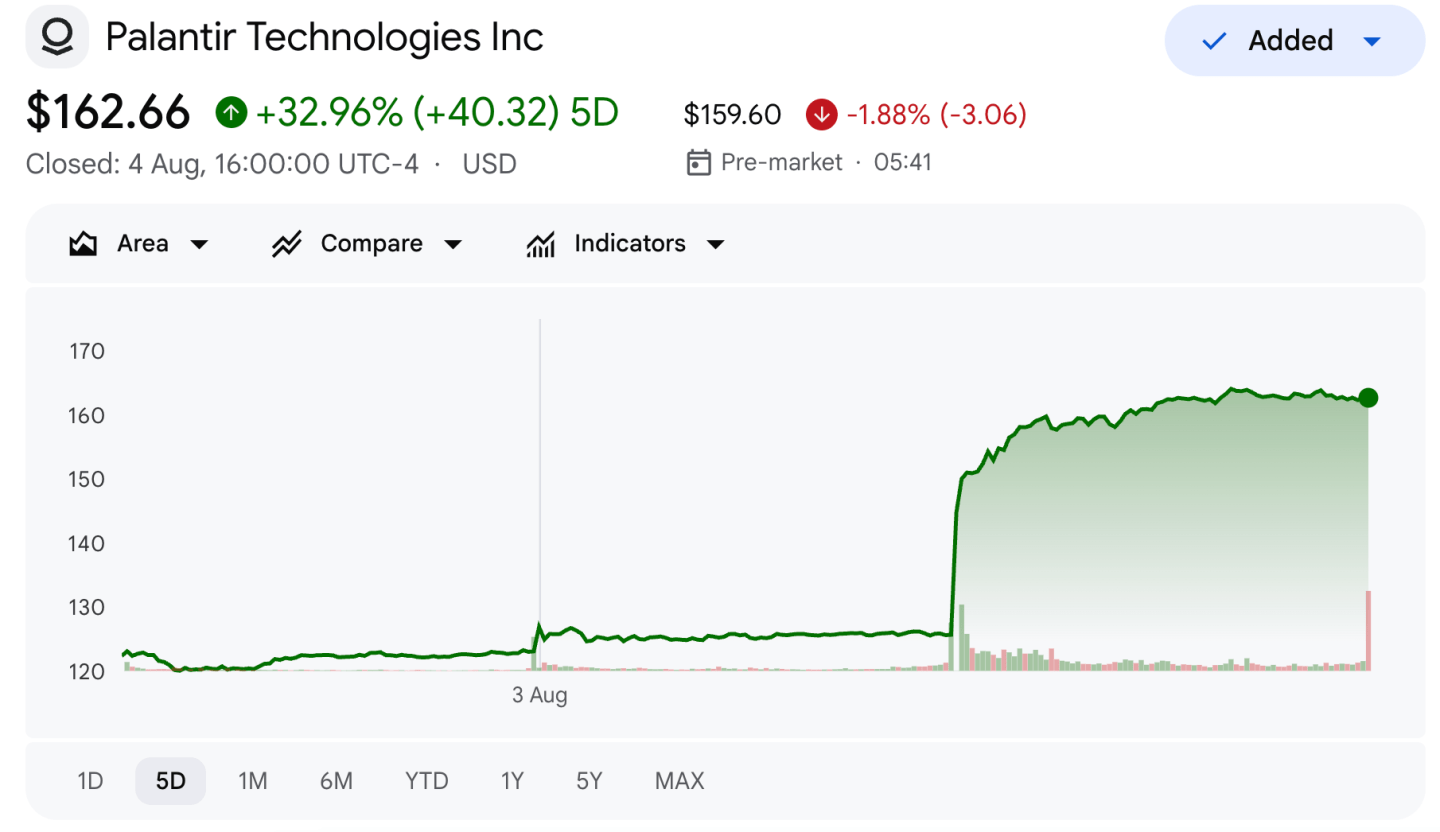
Wall Street’s favorite indicator: number go up
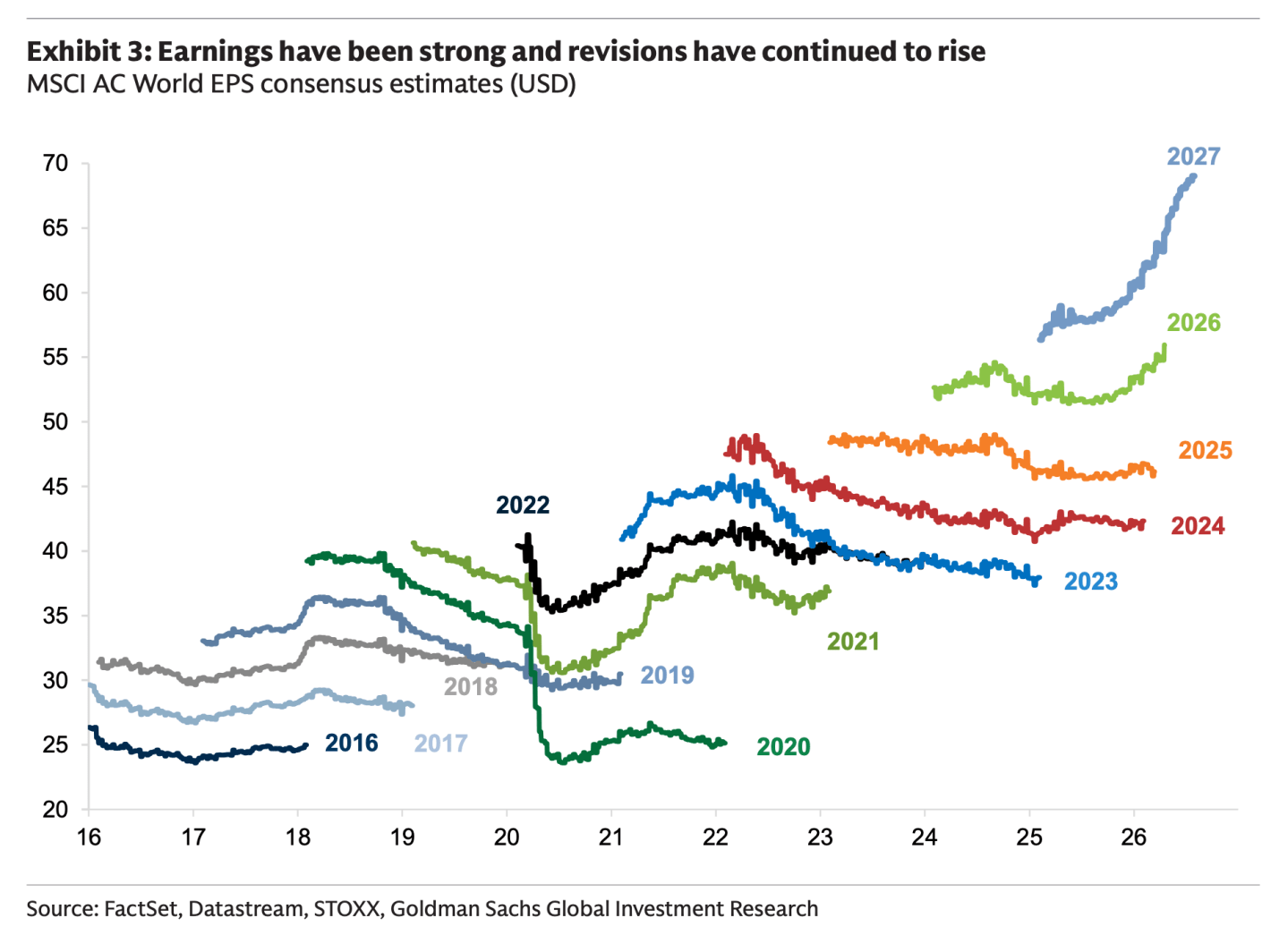
The S&P 500 has been doing well recently and one reason for that is analysts’ estimates of future earnings keep being revised upwards, as this chart from Goldman Sachs’ Peter Oppenheimer shows. This is unusual, he said in a note, because analysts usually revise their estimates downward as the year rolls on.
The S&P 500 is much less dependent on the Magnificent 7 than it used to be
Fact of the day: “While the S&P 500 was down slightly in July (-0.1% total return), the equal-weighted S&P 500 gained 1.0% and breadth improved: 61% of stocks beat the S&P 500, up from 46% in 1H26 and 30% in full-year 2025,” Bank of America’s Savita Subramanian said in an email.
OUCH!
Goldman’s Hatzius tells Kevin Warsh he’s making a mistake
Analysts have been grumbling for a while about Fed Chairman Kevin Warsh ending the “forward guidance” the central bank used to give about where monetary policy is heading. But on Monday one of the bigger beasts of Wall Street, Goldman Sachs Chief Economist Jan Hatzius, came out guns blazing at Warsh. There is a “fundamental problem with this approach,” he argued in a note, because giving markets less information about what the Fed is doing will make them more “error-prone.”
It could, he said, lead to a “hall of mirrors” in which traders make a wrong guess that the Fed is about to hike rates and the Fed then accidentally takes it seriously. “Fed officials might take the resulting interest rate move as conveying new information about the economy and hike, market participants might take this as foreshadowing further hikes down the road, and so on,” he told clients.
“The problem with this approach is that participants in short-term interest rate markets—where Fed communication matters most—price what they think the Fed will do, not what it should do. This remains true if the FOMC provides less information about its reaction function, except that markets will then be more error-prone,” he wrote. In the absence of reliable information, “It could … lengthen the lags of monetary policy and introduce unnecessary volatility into financial conditions and the real economy.”
CHART OF THE DAY
Does this chart predict the jobs number?
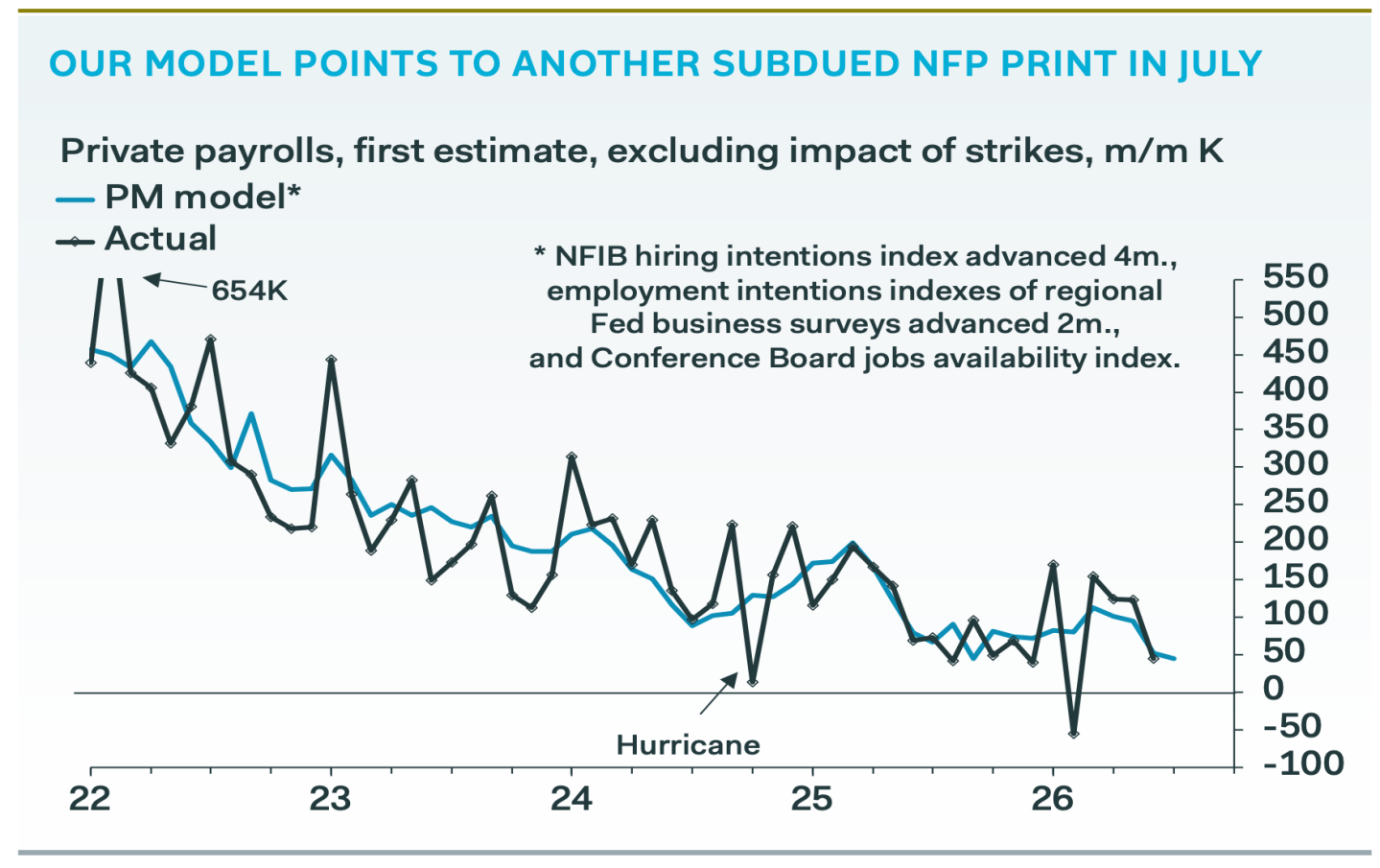
This chart plots the National Federation of Independent Business survey on hiring intentions against the government’s private payroll numbers, and, as you can see, the NFIB line roughly predicts the direction of the job numbers four months in advance, according to Pantheon Macroeconomics’ Samuel Tombs. He thus forecasts that the government will report 75,000 new jobs on Friday.
That will not be strong enough to tempt Fed chair Kevin Warsh into hiking interest rates in September, Tombs and his colleague Oliver Allen say. That’s a counterintuitive take because right now a 62% majority of bets in the CME FedWatch futures market are saying there will be a rate hike, of 0.25%. “The pressure on the Fed to tighten this year will evaporate quickly, unless the inflation data are awful. That’s possible, but the wages data make it unlikely,” Allen said in a note to clients.
NUMBER OF THE DAY: WATER LEVEL IN THE RHINE
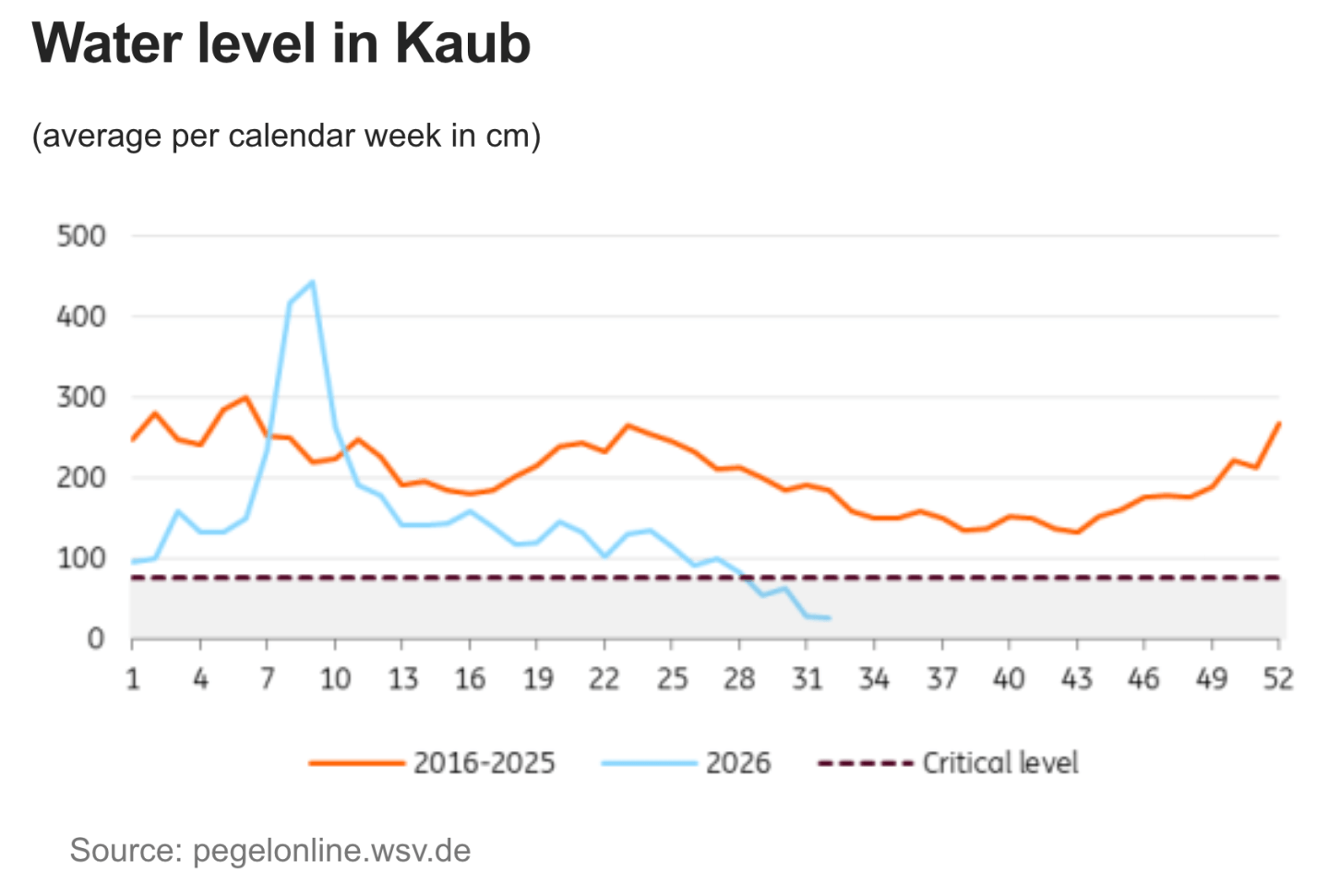
24 centimeters
Roughly 285 million tons of freight are shipped by barge along the Rhine annually, and with each barge holding the equivalent cargo of 100 trucks, it is one of Germany’s major logistics corridors.
But the long, hot European summer has reduced water levels in the Rhine to below critical levels. At Kaub, one of the shallowest points in the river, it’s now less than 24 centimetres deep, the lowest since records began in 1880, according to Carsten Brzeski of ING. The disabling of the Rhine is so severe it could shave 0.3% of German GDP this year, he believes.
WHAT THE HECK
Parts of NASA’s Space Shuttle were made with human saliva
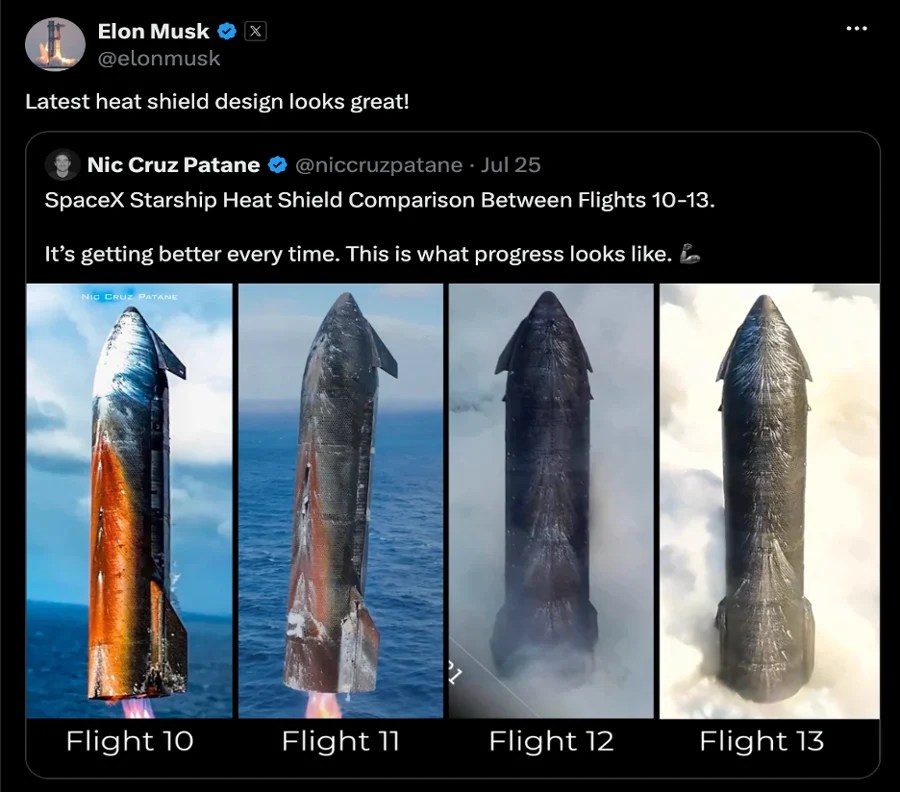
One of the reasons Cathie Wood’s ARK Invest is so keen on SpaceX is that Elon Musk’s rocket company is far faster at making replacement parts for its rockets than NASA ever was with the Space Shuttle. In turn, that lowers the costs for getting things into space. This quote from ARK’s Tasha Keeney says it all:
“Each tile on the Space Shuttle was unique, all of them taking two labor-years to attach and more than 17,000 labor-hours per flight for inspection, replacement, and maintenance. The project was born of blood, sweat, tears—and spit. Initially, the adhesive adhering to the tiles would dry so quickly that workers would spit on it to slow the process down, a practice NASA identified and discontinued. Starship’s tiles are standardized and produced on an automated production line at a rate of one per 13 seconds, a fraction of the three days necessary to fabricate and install a single Shuttle tile. Recently, SpaceX completed a full tile strip-and-replace in two weeks, roughly four times faster than the Shuttle ever managed.”
THE FRONT PAGES TODAY
Donald Trump trapped between escalation and an Iran deal on Tehran’s terms – FT
An Angry Trump Struggles to Understand Iran’s Defiant Leaders – NYT
Novo Nordisk CEO defends economics of Wegovy pill as lower prices weigh on sales; shares fall – CNBC
The Investing Heavyweights That Backed Situational Awareness Before It Blew Up – WSJ
China Hits Back at US With Tighter Drone Export Curbs, Sanctions – Bloomberg
ONE MORE THING
Tommy Bahama CEO admits the company once made swim shorts for men who don’t swim
If you’ve ever walked past all the floral shirts in a Tommy Bahama store at a beach resort and wondered who the heck shops there other than tourists whose luggage was lost, CEO Doug Wood is happy to tell you. The company used to have an internal joke about its men’s swimwear line, he told Fortune’s Cat Gioino: “We sold men’s swim, but our swim never got in the water, so our guy didn’t swim. Our guy just laid around the pool and drank martinis.”
Today, “Nothing could be further from the truth about men’s sportswear,” Wood said. “Now you better have performance something in that product. It better breathe, it better wick.”
Context: TB is doing very nicely, thank you. Sales were up 3.9% to $224.6 million in Q1. That’s a lot of pool dudes.