
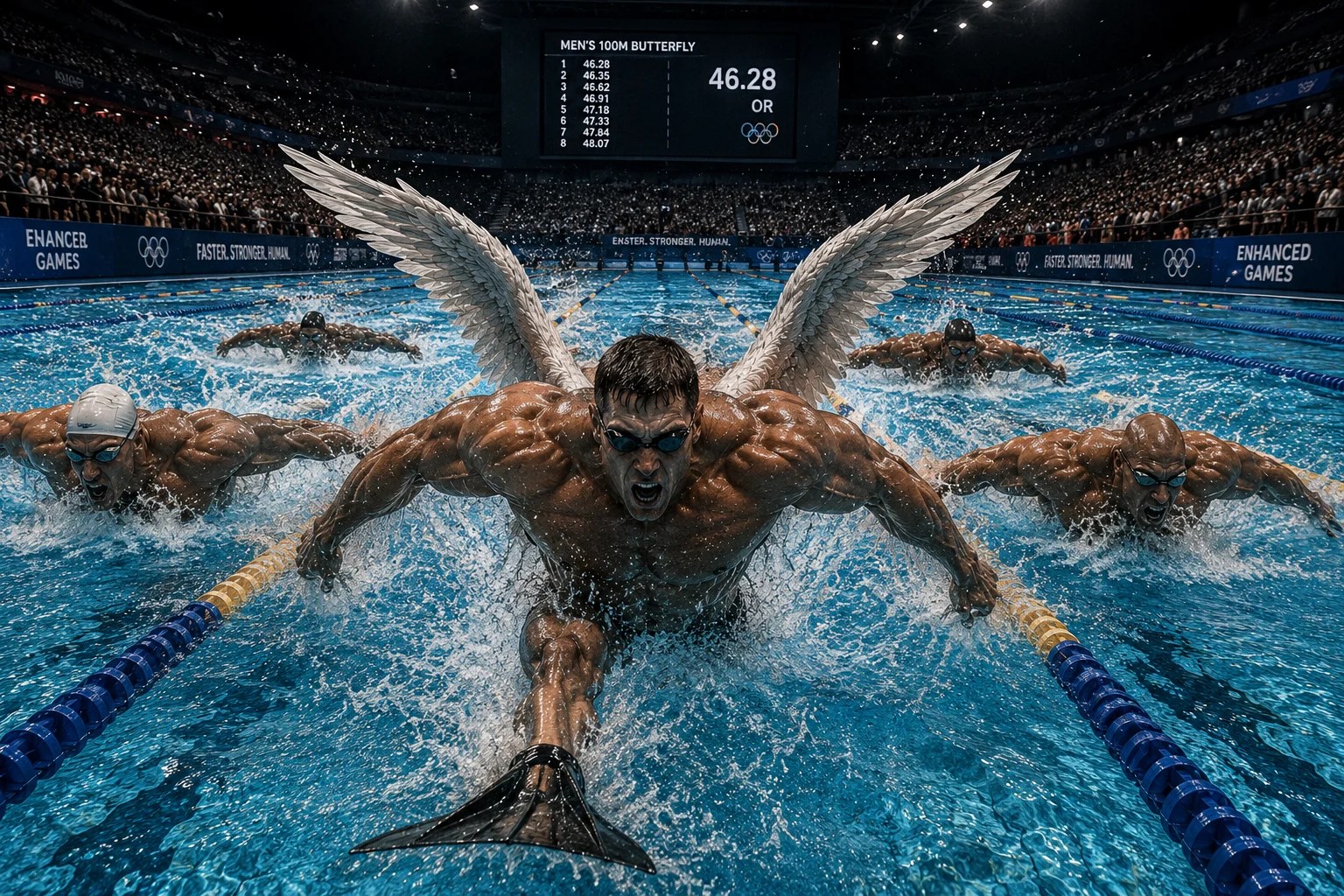
The Enhanced Games is forcing sports fans to confront a question nobody wanted to answer: how far should athletes go for greatness?
Enhanced Games is either the future of sports or the beginning of a conversation nobody was ready to have. And now the world is standing on the edge of a very strange cliff.
Look, we have seen rebellion before, but what is this? We have seen leagues try to challenge the establishment, but at the expense of their health? We have seen athletes bet on themselves, but gambling their lives away? But this one feels different.
The Enhanced Games are coming to Las Vegas today (May 24, 2026) with a simple and controversial proposition: if money, science and human limits all collide in public, what actually happens? OK, my ears are perked up.
The answer comes with a lot of zeros.
According to a presentation, the event is putting up $25 million in prize money in a single day. Swimming races carry a $500,000 purse with $250,000 going to the winner. There is even a headline grabbing bonus of $1 million for breaking the 50 meter freestyle world record.
Now here is where things start getting uncomfortable and weird.
Former Olympians and world champions are signing up. Former Australian star James Magnussen reportedly came out of retirement and publicly discussed using testosterone and other approved compounds under medical supervision to chase history. Ben Proud also joined the movement despite reportedly losing support from traditional governing structures and becoming ineligible for future sanctioned competition. They are risking it all.
The organizers are framing this as transparency instead of secrecy. As you know, everyone is trying to get an advantage.
They say athletes receive physician oversight, blood work, nutrition programs and only use FDA approved substances under monitored conditions. Their argument is not that performance enhancement has no risk. Their position is that athletes should choose their own level of risk. People were not having that and the backlash arrived immediately.
Traditional swimming authorities reportedly moved aggressively against participation and critics warned about health risks and the message being sent to younger athletes.
Now here is my question.
If athletes spend decades destroying their bodies for prestige and tiny checks, was the system already broken? Think about it.
I am not endorsing this. I am not condemning it either. Not yet.
But when somebody puts a million dollars at the end of Lane 4 and says, “Show us what humans can really do,” somebody is going to jump. Capitalism, baby!
And apparently, we are all going to watch. YEP.
https://www.instagram.com/reels/DYsQ0c0uFj2
The core categories of competition include:
- Aquatics (Swimming): Features races across various styles (freestyle, butterfly, backstroke, breaststroke).
- Athletics (Track & Field): Includes the 100-meter dash.
- Strength (Weightlifting & Strongman): Focuses on maximum power output, including Olympic lifting disciplines and the strongman deadlift.
- Gymnastics: Showcases elite acrobatic and body-control performances.
- Combat Sports: Encompasses various forms of regulated, high-intensity martial arts and fighting disciplines.
Related