
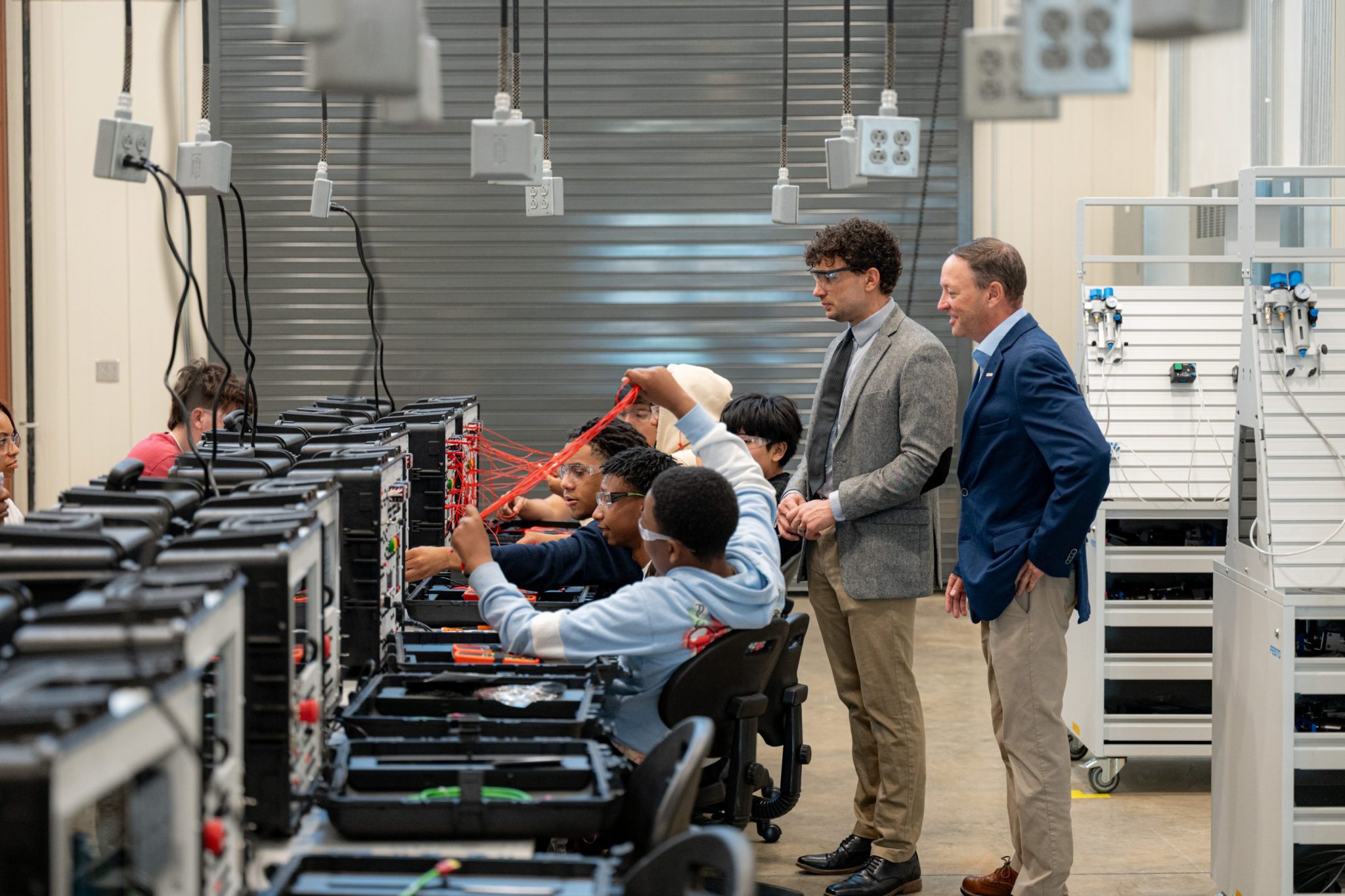
The U.S. has a dire shortage of skilled tradespeople. A school in Huntsville, Ala., is attempting to replenish the talent pool—one teenager at a time.
The Huntsville Center for Technology (HCT) is a new $40 million facility where 700 students leave their traditional high school for part of the day to receive industry-standard training. The school, which will send off its first graduates this spring, features a specialized “Inditech” program developed through a direct partnership with Toyota Alabama, supported by a $1 million investment from Toyota’s charitable endowment.
The school’s principal, Zac Mcwhorter, told Fortune the program launched as a reaction to the town’s biggest employment gaps. Toyota’s facility in Huntsville is one of its biggest in the U.S., assembling nearly half of the car company’s engines in North America.
“We asked what is a specific program or pathway that you guys need and we can address,” he said. “They said they needed more industrial maintenance workers. So the Inditech program came about through the collaboration with Toyota Alabama.”
Many workers in the skilled trades today are of retirement age, and a looming shortage risks costing the U.S. $1 trillion a year, according to some estimates. The U.S. needs about 1.9 million manufacturing workers by 2033, according to 2025 data from the National Association of Manufacturers.
The problem has grown even more dire as data center developers seek skilled electricians, construction workers, and other trades professionals to help build the massive AI infrastructure buildout.
Ford CEO Jim Farley has said the U.S. is short more than one million workers in what he calls the “essential economy,” the blue-collar sectors that get things “moved, built, or fixed.” He said the country is short 600,000 factory workers and 500,000 construction workers.
On the flip side, there’s an oversupply of college-educated white-collar workers in today’s economy. AI automation stands to replace large swaths of the roles young college grads are eager to take. Because of this imbalance, many Gen Zers today are reconsidering the climb up the corporate ladder, weighing gig or freelance work and entering the trades.
How to fill a critical talent shortage
HCT isn’t the only organization responding to the dire shortage of skilled tradespeople. Lowe’s and BlackRock have committed resources to prepare workers for careers in skilled labor. Others, like Dirty Jobs host Mike Rowe, are giving away $10 million in scholarships to motivate young people to find a career in the skilled trades.
Salaries for skilled tradespeople are rising, especially as data center developers seek to attract top talent. Data center construction workers could earn an average of about $81,800 annually, according to data from Skillit, an AI-powered hiring platform for construction workers.
HCT’s Inditech program trains students for industrial maintenance rather than data center construction. But instructor Jack Crowley said the financial benefit isn’t lost on his students, regardless of where they end up. He said that for the roles he’s training students to pursue, a two-year degree and a couple years of experience suffice for a high-income salary early in their careers.
“You’d be making over $40 an hour, for which with little to no student debt, is a very good proposition for income at an early stage,” he said.
Meanwhile, a couple miles away from HCT is the Alabama School of Cyber Technology and Engineering (ASCTE), a magnet high school that integrates cyber tech and engineering across academic disciplines.
The school maintains a similar public-private arrangement with its own slate of local companies, including Deloitte, Airbus, and Raytheon. Raytheon, the aerospace and defense conglomerate, was the first company to pilot the school’s internship program, where students spend four days a week during their senior year working on everything from research to coding.
ASCTE Executive Director Matt Massey told Fortune the program goes beyond the typical internship. The objective is to prepare students to work at companies like Raytheon, and to build a skill set ripe for an AI-dominated economy.
“We’re really trying to prepare them for careers and jobs that don’t even exist right now,” he said.
Building a workforce with knowledge on missiles and defense production has grown increasingly pressing in recent months. The U.S. must replenish stockpiles of critical weapons, including Tomahawks, Patriots, and other munitions that the U.S. and Israel deployed during the war on Iran. If not addressed, a shortage could leave the U.S. vulnerable.
“These experiences build critical skills such as systems thinking, creativity, and collaboration while helping strengthen the future aerospace and defense talent pipeline,” Nate Jones, Raytheon Huntsville site executive, said in a note to Fortune.
To be sure, the programs don’t guarantee positions at partnered firms following graduation. But supplying students with hands-on experience is an integral part of ensuring they are ready for industries that are growing fast and paying comfortable salaries.
For many of the students, the prospect of tangible financial success is what attracts them to these programs.
“When they started hearing that we have a 21- or 22-year-old team member who had gotten married, bought a house, had a car, has a boat, you could just see their eyes lighting up about the potential of this type of career,” Sydney Martin, a corporate comms analyst and a lead at Toyota Alabama for the Inditech program, told Fortune.