
In Greek mythology, Chronos (not the guy who ate his kids), the primordial god of time, was depicted as a giant snake with three heads: a man, a bull, and a lion. Chronos and his consort, the goddess of inevitability, Ananke, circle around the cosmos and drive the rotation of heaven and the eternal passage of time.
This description potentially speaks to how ancient societies viewed time: primordial, grand, and inevitable. It’s probably not too different from the way we think of time (philosophically, anyway), but today, we have an incredible tool: modern science. This has led not just to more objective standards but also to discoveries in unorthodox realities, namely the quantum and cosmic worlds.
So we’ve come a long way from Chronos—or have we? Modern science has shown us that, in some realms, time as we know it appears to break down. But what does that really mean? Are we now beyond time? Do we want to be beyond time? What does our evolving understanding of time mean for the way we understand the universe—and ourselves?
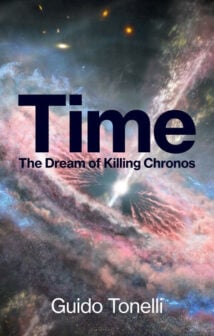
These are the questions that Guido Tonelli asks in his latest book, Time: The Dream of Killing Chronos. Tonelli, a particle physicist at the University of Pisa in Italy, was one of the leading scientists involved in the monumental discovery of the Higgs boson in 2012, for which he received the Special Breakthrough Prize in Fundamental Physics, among many others. Gizmodo spoke to Tonelli about humanity’s relationship with the concept of time, as well as its role in scientific breakthroughs. The following conversation has been edited for grammar and clarity.
Gayoung Lee, Gizmodo: The title of the book is Time: The Dream of Killing Chronos. So, we clearly all know what “time” is, but what’s the “dream of killing Chronos”?
Guido Tonelli: Time is not a question that is of interest for scientists or philosophers. It’s a question inside us—every human being, in particular, after becoming older, has an internal speculation [that has been repeated in] the last few thousand years. Why do we have this continuous activity that deteriorates everything? There is no way to revert the direction of time nor the possibility to escape this destiny that brings everything to the end.
And for millennia, humankind has tried to escape this destiny—to find a way, I call it, to master or to kill Chronos, the god of time. So the dream is to stop the flow of time, or revert it, to become immortal. That’s a dream that’s part of literature, philosophy, science, or science fiction, if you wish.
But the strange part of the story is that, in modern science, there are places in which time stops. Let’s say the center of black holes. The distortion of spacetime is so extreme that time basically becomes meaningless. Modern scientists have discovered regions that Chronos does not rule, but it is better for us to stay far away from these regions because they are dangerous.
Gizmodo: When did the modern concept of time emerge, and for what reason? Why did humans decide on this particular idea of time?
Tonelli: Today we decided to have this interview [based on] the time zones between the U.S. and Europe. We don’t question whether there is a different flow or sensitivity of time in Europe with another part of the world [since around the 19th century]. We share the concept of absolute space and time, which dates back to Isaac Newton and Immanuel Kant from the 17th century. We use this universal clock to arrange and organize our lives, and everything seems to be extremely simple.
Then at the beginning of the 20th century, scientists started investigating the world of microscopic objects, like electrons and atoms—objects so tiny and charged in many cases. They can move easily at speeds similar to the speed of light. And they discovered immediately that [for these particles], time is a completely different object. First of all, you cannot distinguish space and time—they are interconnected. And it is plastic. If you move at the speed of light, you see the space in front of you, which changes, and your time is different from the time of an observer who is not running with you. This was the first revolution: special relativity.
And the second revolution was even more complex. Ten years afterward, Albert Einstein, trying to understand gravity, developed general relativity. He assumed that mass-energy is able to distort and change the shape of spacetime. [This has been] now tested hundreds to thousands of times with incredible precision. But the problem is that these phenomena are visible and measurable in worlds distant from our ordinary world—the world of microscopic particles, or the immense world of cosmic space. And this is so new that normally, people haven’t really realized the beauty of this [view of time], which completely changed our vision of the world.
Gizmodo: You bring up a fascinating point about the distinction between our “daily” world and other worlds with tiny particles or galactic systems. In the former, it’s very clear that time inherently favors a certain direction. If I spill a cup of coffee, I can’t un-spill the cup. But in the microscopic world, things aren’t so clear-cut.
Tonelli: Absolutely. It’s not obvious at all in the microscopic world. For macroscopic objects—us—or galaxies, there is a clear arrow of time depending on the complexity of a system. In the world of elementary particles, we can, in some sense, change the flow of time.
Gizmodo: Physics equations that describe these systems don’t distinguish between, say, t and -t to calculate time as a variable.
Tonelli: Exactly. It’s been proven that you can change—in very simple processes—the sense of time. The same reaction can take place in the other direction. But you also have to change, for example, both charge and parity. There is a total symmetry that can be retained with the appropriate means. But that is less and less true as soon as you increase the complexity, which has to do with entropy. For macroscopic objects, we don’t have this freedom. You can fry an egg, but you cannot go back and obtain the egg.
Gizmodo: In a popular sense, physics is something that seems so fundamental and clear-cut. But in truth, there isn’t much physicists can say with 100% certainty. Perhaps time falls into that category. So is time absolute or subjective?
Tonelli: Human beings have a sense of time embedded in our biology. We don’t have a specialized organ. But the sense of time is something computed in our brain, taking into consideration many inputs coming from what we view, memory, and comparing the length of a certain process with the length that we have experienced in the past.
Physicians have studied individuals that, due to accident or serious illness, lost the sense of time. So, you wake up in the morning in pajamas, and you wash up and take breakfast, and then you get rid of the pajamas, dress up, and go out. But if you don’t have a clear sequence in your brain, you wake up and dress and then go back to bed and then wash and go out naked. This is what happens once you lose the sense of time.
The part of the brain overseeing this sense of time is physically close to the amygdala, the region of the brain that rules our deepest emotions. For instance, there was an earthquake of 7.1 magnitude in Japan. Imagine you’re there for maybe 10 or 20 seconds of a terrible earthquake. You’re paralyzed with fear, and these 20 seconds, in your memory, become minutes. Every nanosecond, you are so vigilant, afraid of dying, so you’re using the smallest intervals of time.
Or if you have a dinner with friends and you are happy, you discover that it is midnight. You’ve had a four-hour discussion, but it seems like they just arrived. Psychological tests also evaluated the sense of time in stressful situations. For example, during important exams, you feel like you’ve been under scrutiny for one hour when it was just a quarter of an hour. Everything really becomes dependent on your emotional state. If you go to the level of elementary particles or planets, the flow of time is independent from the behavior of individuals.
Gizmodo: You are a particle physicist. In your line of work, what does time mean? How has time been relevant to your work?
Tonelli: In quantum mechanics, there is an important law called the Heisenberg principle. We’ve been able to use it as a tool to measure the extremely small lifetime of particles. Among elementary particles, the particles composing ordinary matter are stable and can last billions of years. But there are other particles that are heavier, quarks, for example, which are unstable. Those particles were living well in the baby universe when the average temperature was incredibly high. Now the average temperature is about 3 degrees above absolute zero. That means that most of the particles that are more energetic don’t survive and basically decay into other particles.
If you accelerate those particles to the speed of light and they decay, then the length from the production to the decay can be measured. And you can expand these lengths using relativistic effects to a few millimeters or a fraction of a centimeter. That means you can, with very sophisticated sensors, measure the lifetime of the particle. This is in the range of 10-12 or 10-13 seconds, which is very tiny.
But how can you measure lifetimes at 10-23 or 10-25 seconds? That would be impossible. This is why we use the Heisenberg uncertainty principle, which connects energy and time. This is how we measured the Higgs boson; we measure the energy best we can, and the uncertainty in energy is connected to the lifetime. So we can use the uncertainty principle to measure the smallest possible lifetimes. In some sense, we were measuring using a limitation to increase your knowledge. Now, this for me was fantastic.
Gizmodo: Let’s talk about the possibility of a science beyond time. As far as we’re aware, what is science that goes beyond time? Do you think physics could ever free itself from time?
Tonelli: There are other possibilities. I’m an experimental physicist, so I tend to discuss theories that have been validated by experiments. But I’m fascinated by theories that haven’t been validated. They could be pure fantasy; there’s no proof that this theory will be correct—but there’s a possibility. For some of these theories, time is not a fundamental element but something originating from other, more fundamental qualities.
At the moment, time is an important element of physics. You cannot get rid of time. But tomorrow, we don’t know. Maybe a young scientist will come up with a new theory in which we’ll be able to build our world without using the key element of time. […] These additional discoveries will change our vision of the world.
Time: The Dream of Killing Chronos was published in English on July 28, 2026, via Polity and is now available online or in hardcover.