
Nearly 13 million people uploaded at least one track to Spotify in 2025, up from 12 million in 2024.

Of those 13 million, nearly 8 million have released fewer than 10 songs total, and around half of all those uploading music to Spotify in 2025 were uploading music for the first time.
That’s according to the latest edition of Spotify’s annual Loud & Clear report, published today (March 11), which includes bundles of fresh data on what artists generated from its service in 2025.
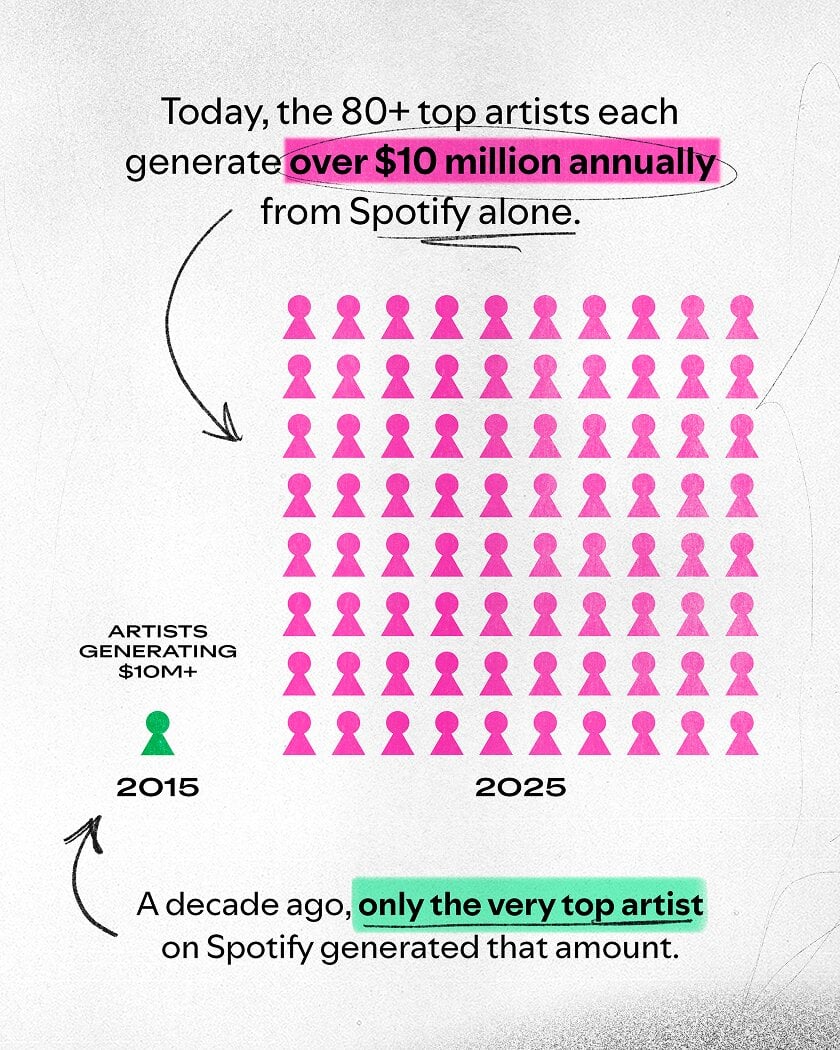
The headline numbers show growth across the board. Spotify notes that a decade ago, the very top artist on the platform reached $10 million in annual royalties for the first time. Today, 80 artists each generate more than $10 million annually from the platform alone.
“As global superstars have graduated to the $10 million level,” Spotify says, “a whole class of career artists have reached the $1 million level” – more than 1,500 strong in 2025.
Spotify says the number of artists earning at every threshold, from $1,000 to $10 million per year, has at least tripled since 2017. But each tier in the pyramid tells its own story.
As the breakdown below shows, from $1,000 to $1 million, the number of artists at each threshold has grown by between 220% and 250% since 2017 – steady, consistent expansion across the streaming middle class.
At the $5 million threshold, artist numbers have grown by 360% since 2017. And at the $10 million level, that figure reaches +700%.
In other words, according to Spotify’s data, more artists are earning at every level – but the growth is fastest at the very top.

Spotify has previously confirmed that it paid out more than $11 billion to music rightsholders in 2025 — up more than 10% on 2024, and bringing its lifetime total to nearly $70 billion.
Here is how the Loud & Clear data breaks down at each royalty threshold in 2025 (note: these figures represent total royalties generated on Spotify, inclusive of both recording and publishing. Spotify notes it does not have visibility into what artists ultimately take home after their arrangements with labels, distributors, and publishers):
- 303,200 artists generated more than $1,000 (91,200 in 2017; +230%);
- 81,100 generated more than $10,000 (23,400 in 2017; +245%);
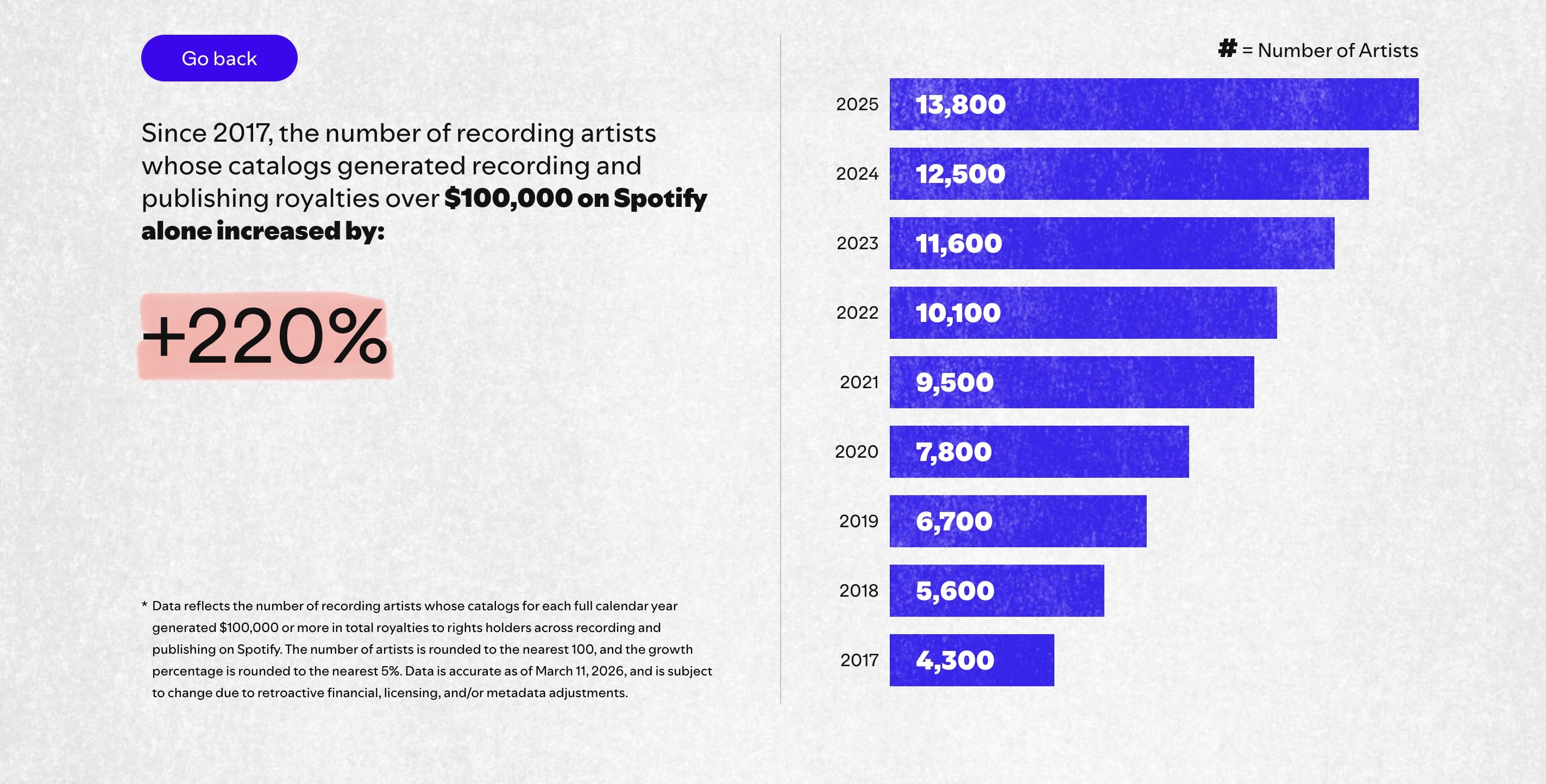
- 13,800 generated more than $100,000 (4,300 in 2017; +220%);
- 1,540 generated more than $1 million (460 in 2017; +230%);
- 230 generated more than $5 million (50 in 2017; +360%);
- 80 generated more than $10 million (10 in 2017; +700%).
Sam Duboff, Global Head of Marketing & Policy, Music Business, told MBW: “10 years ago, the very first artist reached $10 million a year for the very first time. Now, the top 80 earning artists on Spotify generate $10 million.”
That shift, Duboff said, has redefined what the million-dollar tier represents. It is now home to “a whole new set of career artists who aren’t household names, generating a million a year from one platform.”
More than 80% of artists generating $1 million+ on Spotify in 2025 never had a track reach the platform’s Global Daily Top 50 chart. “They don’t have a chart-topping song,” said Duboff. “They’re building it through a sustained fan base over time.”
He added: “If you get 1% of streams from 1% of listeners, that’s enough to earn a million dollars a year.”
Spotify also highlights the growth in the number of artists at the $100,000 level, noting that there are now more artists generating six figures annually from the platform alone “than were getting stocked on record store shelves at the height of the CD era.”
Duboff was keen to emphasise that growth is not confined to the top of the pyramid.
He pointed to the 100,000th-highest-earning artist on the platform, who generated more than $7,300 in 2025 — up from approximately $350 in 2015.
“That’s 20x growth,” he said. “That’s three times faster than the growth for the 10th-ranked artist.”
In other words, there are two different stories in the data. The number of artists reaching the very highest thresholds ($5 million, $10 million) is growing fastest. But the royalties generated at individual positions lower down the pyramid are growing at a faster rate than those near the top.
“You’re seeing even faster growth for emerging artists at earlier stages in their career,” Duboff said. “That’s what speaks to increased artist opportunity. DIY artists, artists from smaller music markets, are able to have a viable career in music now.”
There were 13 million uploaders to Spotify last year, but how many are actually trying to make a career in music?
Spotify estimates there are approximately 250,000 professional or aspiring professional artists on the platform globally — up from an estimate of 225,000 last year.
It arrives at that figure by cross-referencing two data points: around 288,000 artists have released 10 or more songs and average 10,000+ monthly listeners, while 218,000 listed at least one live or virtual event in 2025 via ticketing partners including Bandsintown and Ticketmaster.
Splitting the difference, Spotify considers 250,000 “a reasonable estimate.”
Of the ~13 million uploaders, only 3.5 million – roughly 27% – had at least one track that qualified for recording royalties in 2025 (i.e. a song with 1,000 or more annual streams, the minimum threshold under Spotify’s demonetisation policy introduced in 2024).
Spotify says that average recording royalties earned per monetized song have “more than tripled” from 2023 to 2025 as a result of the policy.
Expressed as a percentage of Spotify’s total uploader base, the picture narrows considerably.
- Of those ~13 million uploaders, some 81,100 – roughly 0.62% – generated $10,000 or more.
- The 13,800 artists who generated $100,000+ represent approximately 0.11% of all uploaders.
- The 1,540 who crossed the $1 million threshold account for 0.012%.
However, Spotify notes that the vast majority of its uploaders are not pursuing a music career.
“Just like posting a video to YouTube doesn’t make you a professional YouTuber,” the company says, “uploading a song doesn’t mean you’re pursuing a music career.”
Measured against its estimate of 250,000 professional or aspiring artists, more than 30% earned $10,000+ from Spotify alone in 2025.
Spotify says it now accounts for approximately 30% of global recorded music revenue – a figure it calculates based on data from IFPI‘s 2025 Global Music Report – and suggests those artists likely earned around $30,000 or more across all recorded income sources.
DIY and discovery
Elsewhere in the report, Spotify says that more than a third of the 81,100 artists who generated $10,000+ in 2025 were DIY artists who self-release through independent distributors, or began their careers that way.
Spotify says more than 90% of DIY royalties went to artists who have been releasing music for more than a year.
Duboff told MBW that some artists build “up to million-dollar-plus careers staying DIY,” while for others, self-releasing serves as a launchpad. “DIY is that entry point,” he said. Artists can “prove themselves without any barrier to entry” and accumulate “a lot of proof points, a lot of data, a lot of a fan base, before they decide to go the label route.”
More than 1 in 10 artists generating over $100,000 annually were first playlisted within Spotify’s Fresh Finds ecosystem, its editorial program for emerging indie artists. That amounts to more than 1,600 artists who were surfaced early by the platform and have since built six-figure streaming careers.
Duboff said that on average, artists’ royalties and listenership “more than doubles” in the year after being added to a Fresh Finds playlist.
Global growth
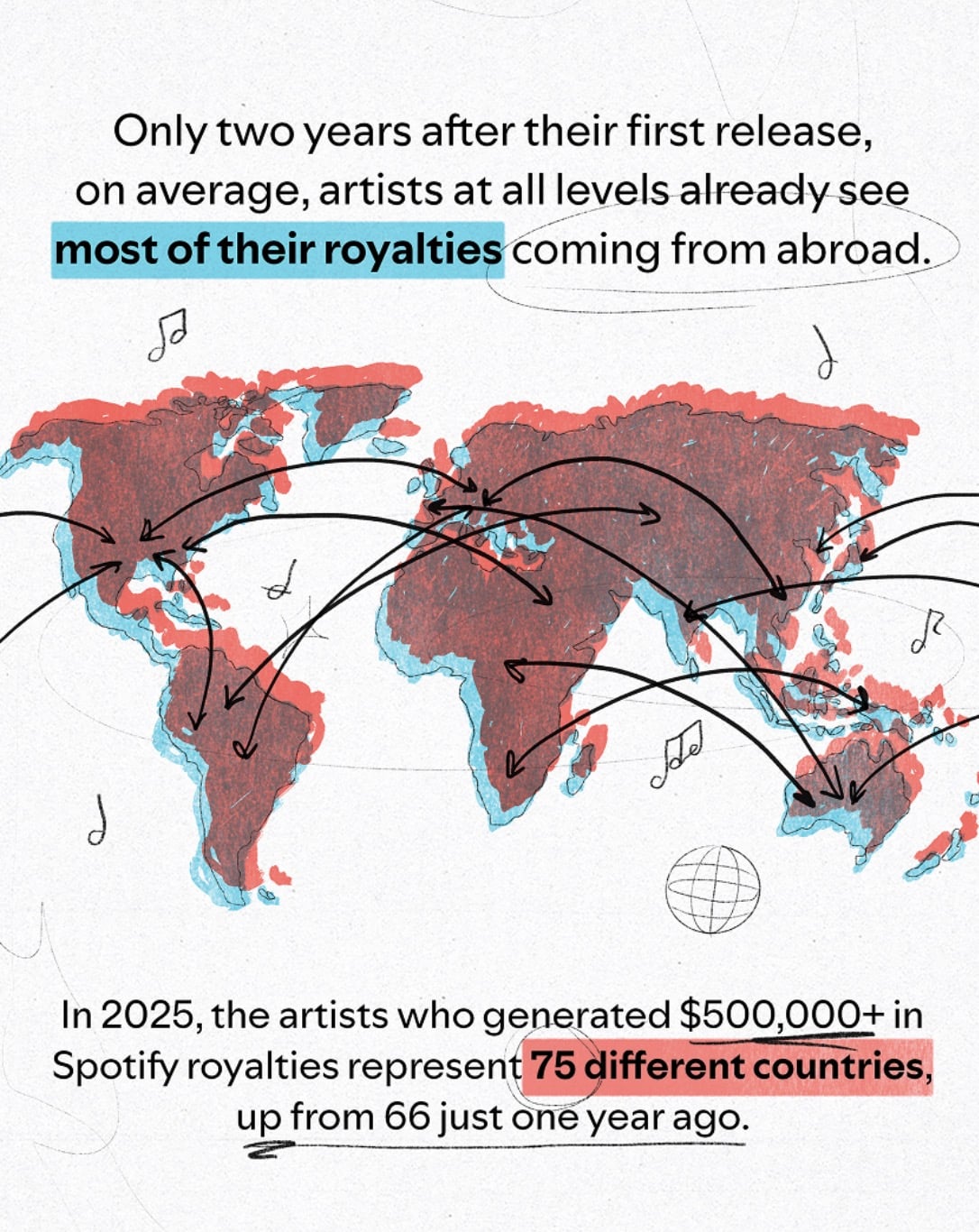
Artists generating more than $500,000 in Spotify royalties in 2025 represented 75 countries, up from 66 the year prior. At the $10,000 level, artists from more than 150 countries generated as much on the platform.
Songs in 16 languages reached Spotify’s Global Top 50 in 2025 – more than double the number in 2020. Among genres generating over $100 million in Spotify royalties, the fastest-growing were Brazilian funk (+36%), K-Pop (+31%), Latin trap (+29%), Latin urban (+27%), and reggaeton (+24%).
Duboff told MBW that a handful of emerging markets saw royalty growth of over 30% YoY, and tied that to the genre data.
“The types of genres that never found traditional success before streaming are now the fastest-growing genres in terms of revenue,” he said.
On average, artists see more than half of their royalties coming from outside their home country just two years after debuting, according to the report.
Publishing and live
Spotify says 2025 marked its largest-ever annual music publishing payout, with approximately $5 billion paid to publishers and organizations representing songwriters over the past two years.
Duboff told MBW the company had seen “over 2.5x growth in publishing payouts over the past five years,” adding: “The opportunity for songwriters in terms of Spotify revenue is growing, and growing fast, but has also reached a real threshold of materiality.”
Spotify said last year that it had paid out nearly $4.5 billion to publishing rightsholders globally over the prior two years, adding that the payout saw “double-digit percentage growth” from 2023 to 2024.
Separately, the company claims to have driven more than $1.5 billion in gross concert ticket sales for artists to date – a figure included as a Loud & Clear takeaway for the first time this year.
Duboff said that for around 40% of touring artists on the platform, ticket sales now increase their total Spotify-generated revenue by at least 10%. “Royalties are always going to be our focus,” he said, “but you could imagine other real pillars of the revenue opportunity we’re driving for artists around live as well.”
“The magic we think we bring is knowing exactly who your biggest fans are, exactly where they live, exactly the venues they want to go to, and presenting that in really interesting ways.”
Sam Duboff, Spotify
He pointed to recent product launches including venue pages, where users can follow local venues, and a ‘Concerts Near You’ playlist that surfaces music from artists with upcoming shows in a listener’s area.
“The magic we think we bring is knowing exactly who your biggest fans are, exactly where they live, exactly the venues they want to go to, and presenting that in really interesting ways,” he said.
Music Business Worldwide